Project 01
LARAS
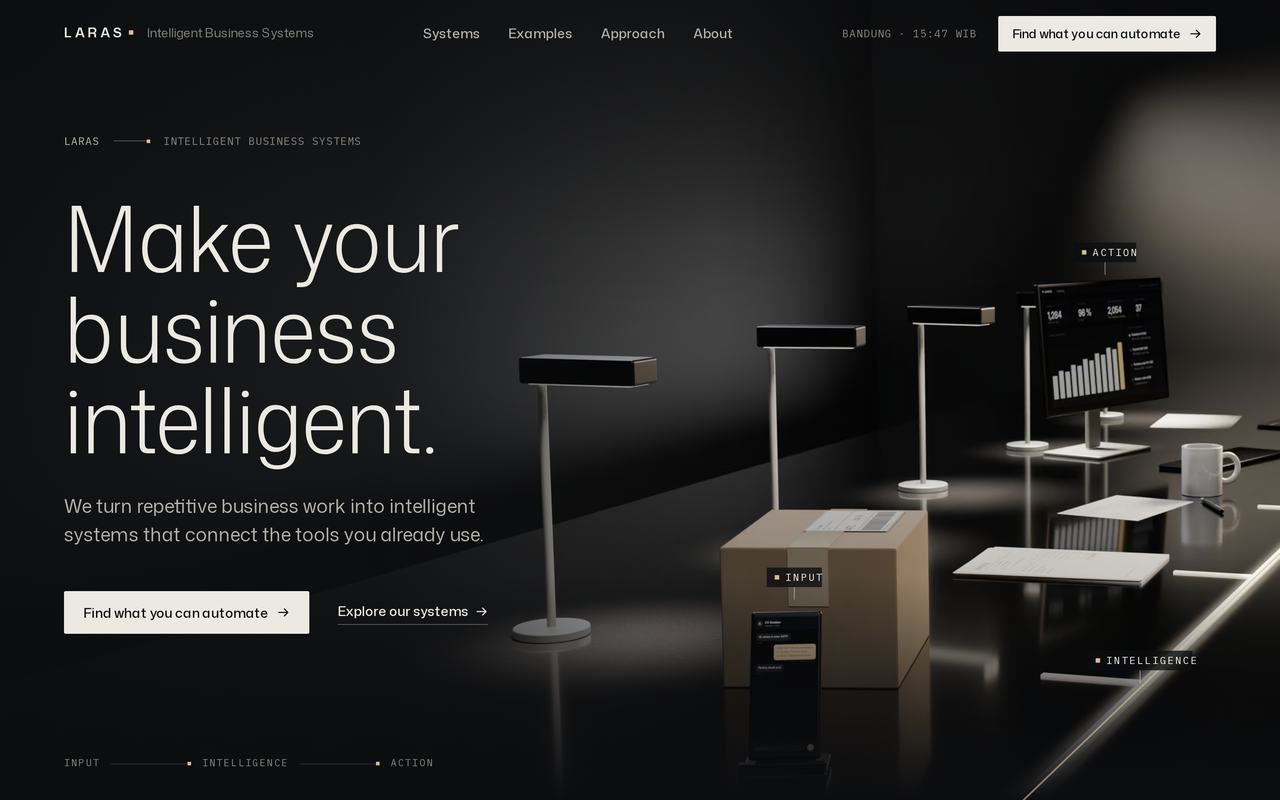
A company site for Laras, an AI and automation studio: original 3D scenes, one honest simulation, and a home page that loads in fifteen requests.
- For
- Laras — AI systems, automation and business systems
- Whose
- For our collaborator
- Year
- 2026
- Work
- Design, Development, Performance
- Live
- laras.tech
The problem
Explain work nobody can see — automation, AI agents, integrations — to a business owner, without a client logo, a statistic or a testimonial to lean on, because none existed yet.
What exists now
A seven-page static site in which every picture is an original 3D scene that explains one idea, and the one simulation on it says plainly that its data is invented.
Context
Laras builds automation, AI agents and integrations around the software a business already runs.
It is the studio TULUS works with when a project needs more than a website. In September 2026 it
had a domain and no site: laras.tech answered with the registrar’s parking page.
Problem
The work Laras sells is invisible. A system that reads an order, checks stock and drafts a reply has nothing to photograph. The usual answers — stock pictures of glowing brains, a wall of client logos, a row of large statistics — were not available, because none of them would have been true. There were no published clients and no results to quote.
Constraints
- Nothing on the site may be presented as real unless it is. Anything simulated carries a label.
- No testimonials, no client logos, no statistics without a source.
- No tracking scripts. The contact route stores nothing.
- One language at launch.
Approach
Show the work, literally. Every picture on the site is an original 3D scene of things a business owner recognises — a parcel, an invoice, a phone with a message on it — arranged so that the picture explains one idea before any caption does. The depth of the offer moved off the home page into five pages, so the home page could ask one question at a time.
Design
One motif runs through the site: a line from input to intelligence to action. The page is nearly black with a single warm accent, and the accent is carried only by things that move. Two typefaces. A simulation of one enquiry from arrival to reply lets a visitor approve or send back a step, and states on the page that its names, numbers and times are invented.
Development
A static site: seven HTML pages, hand-written CSS, a few small scripts, no framework running in the browser. Pictures are served as AVIF with a fallback, in sizes matched to the screen. Contact links open WhatsApp or an email; there is no form endpoint and nothing is stored. Deploys take a snapshot first, refuse to publish a copy that is behind the published one, and check afterwards that what is live is what was built.
SEO
The foundations, and nothing claimed beyond them: one h1 per page and an ordered outline, the
content in the server’s HTML rather than assembled by script, a canonical address, a title and a
description per page, Organization and WebSite structured data, a seven-address sitemap. No
keyword targets were set and no ranking is reported, because none was measured.
Performance
The home page arrives in fifteen requests and about a quarter of a megabyte, all from its own address. The largest single file is the typeface. Lighthouse reports 100 in all four categories on all seven pages; that is a lab score we ran ourselves, and we say so.
Results
What was measured is in the table, with the date and the instrument. What matters most to a business — whether the site brings enquiries — was not measured, and the table says that too.
| What | Result | When and how |
|---|---|---|
| First load of the home page, desk | 15 requests · 252 kB | . Headless Chromium with an empty cache, bytes on the wire, measured from Bandung. None of the requests goes to a third party. |
| First load of the home page, phone | 15 requests · 191 kB | . The same instrument at 390 × 844. |
| Lighthouse, all seven pages | 100 · 100 · 100 · 100 | . Performance, accessibility, best practices and SEO on the desk and phone profiles, run by us on the build machine. A lab score: it says the page can be fast, not that every visit is. |
| Automated accessibility check | 0 violations | . axe-core in headless Chromium, run by us. An automated check finds only part of what a person would. |
| Search visibility | Not measured. | No Search Console data has been recorded for this site. |
| Enquiries | Not measured. | The site loads no analytics, and its contact links open WhatsApp or email. There is nothing to count. |
| Speed for real visitors | Not measured. | Field data needs traffic and a measuring script. The site has neither, by decision. |
Lessons
The first two sets of pictures were licensed photographs. They were well lit and they said nothing: a studio that builds custom systems looked like every other page using the same warehouse. Building the scenes ourselves took longer and made each picture specific. And the home page improved each time it lost words: what stayed was what a visitor needed in order to take the next step.
The page’s own record
Read from laras.tech on . A site changes; this is what it said that day.
- Title
- LARAS — Intelligent Business Systems
- Description
- LARAS builds intelligent business systems: automation, AI agents and integrations that turn repetitive work into reliable operations, around the software you already run.
- Canonical
- https://laras.tech/
- Robots
- index, follow, max-image-preview:large
- Language
- en
- Structured data
- Organization, WebSite
- Landmarks
- header · nav × 2 · main · footer
- Links
- 25 internal, 3 external
- Images
- 14: 6 described, 8 decorative, 0 without alt
- Document
- 645 elements, nested 11 deep
- First load
- 15 requests, 252 kB, 0 to third parties
Heading outline
- H1 Make your business intelligent.
- H2 Your business already has software. It needs better systems.
- H2 What could you automate?
- H2 We don’t start with AI. We start with the work.
- H2 One inquiry, end to end.
- H2 Bring the business into tune.
- H2 What work in your business should be automatic?