SoloLuck
A website for people who mine Bitcoin solo at home: live figures that show “—” rather than a false zero, the odds as a worked formula, and ways to check the pool.
The problem. A solo pool has no win to point to until one of its miners finds a block, and on 30 September 2026 no Bitcoin block had yet been found on SoloLuck. The site still had to answer the first question: if I find one, do I get paid?
- Business
- Bitcoin infrastructure
- Year
- 2026
- The work
- Product UX, Web development, Information architecture, Technical content, Technical SEO
- Site
- sololuck.io
Problem
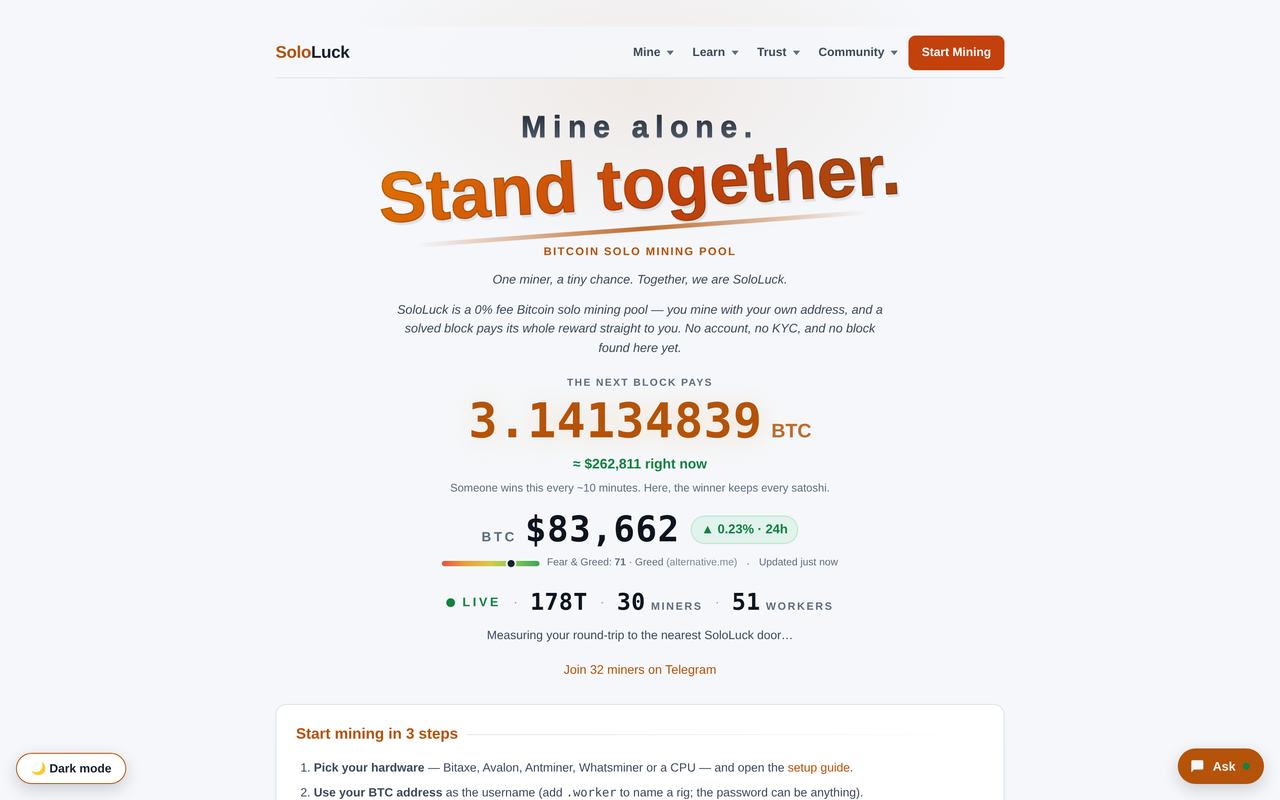
SoloLuck is a solo mining pool for Bitcoin, and since September for Bitcoin Cash and DigiByte too. It charges no fee and holds nothing on a miner’s behalf: the miner’s own address is the username, and a block that miner finds pays that address directly. It is made above all for small machines at home: a Bitaxe, a NerdMiner, an Avalon Nano.
A pool usually proves itself with its record. A solo pool has none until one of its miners wins, and, as its home page said on 30 September 2026, no Bitcoin block had been found on SoloLuck yet. The site still has to answer a new miner’s first question, if I find a block, do I get paid?, with what it can show: true figures, arithmetic that can be checked, and a page where miners watch their own machine.
Thinking
- Live data, and “—” instead of 0. Every figure comes from live data. A zero says nothing happened; a dash says there is no reading. On a pool, a false zero is a small lie that looks like data.
- The formula, worked. Beside the calculators, the odds are written out as
P = 1 − e^(−t/T)and worked through, so a miner can check a number instead of trusting it. - Corrections are annotated, not rewritten.
- Trust has its own place. The navigation has four groups: Mine, Learn, Trust, Community. Trust holds the ways to check the pool: verification, payout proof, uptime history, a risk disclosure.
- Claims carry sources. Guides and blog posts cite a source for each claim and keep a record of their reviews.
Surface
The home page opens with “Mine alone. Stand together.”, then what the next block pays in BTC and in dollars, the Bitcoin price and the pool’s live figures. The site is in English, in a light and a dark theme.
- Connect. The setup page asks for the miner’s hardware and Bitcoin address, checks the address’s checksum, then shows the exact settings to copy or to scan as a QR code.
- Watch. Every address has a public stats page showing its best share over time, a view added because a miner asked for it. There is a dashboard, a status page, high scores and a census across pools.
- Work out the odds. A calculator for each chain; the odds calculator can be embedded on another site through oEmbed. Your Block shows exactly how the reward of a found block would be split.
- See who has won. Solo Legends records the blocks small miners have won on solo pools, verified on-chain, with a page for each block.
Structure
Information architecture
The four groups head both the navigation and the footer, with the same pages under them in each.
Built from data
The content is kept as data (JSON). Every page generated from it brings its own structured data and its own sitemap entry, so a page is listed from the moment it exists: guides, blog posts and a page per Solo Legends block. That record is also open data, in JSON and CSV, under CC BY 4.0.
Code
- One server written with Python’s standard library renders every page as HTML: inline CSS, charts as inline SVG, no framework.
- The home page’s content security policy,
default-src 'self', tells the browser to load nothing from a third party.
Search
One h1 on the home page; structured data for Organization, WebSite, Service and FAQPage; lang="en",
with hreflang for en and x-default only.
The record
SoloLuck went up on its own address on 20 June 2026 with an odds calculator, an FAQ and a sitemap. Then it changed in steps: a rebuilt navigation and one footer on 2 July, the open dataset and an embeddable calculator on 14 September, and a page per block on 18 September, every deploy passing a gate of automated checks. The pool’s own numbers (miners, hashrate, blocks) describe the mining, not the website, and are not in the record.
Every figure with the date and the instrument that produced it. Where there is no figure, the record says why.
Snapshot
Read from sololuck.io on . A site changes; this is what it said that day.
- Title
- SoloLuck — 0% Fee Bitcoin Solo Mining Pool
- Description
- SoloLuck is a 0% fee Bitcoin solo mining pool — true-solo and non-custodial. Find a block, keep the whole reward. No KYC, no signup, open worldwide.
- Canonical
- https://sololuck.io/
- Robots
- index,follow,max-image-preview:large
- Language
- en
- Structured data
- Organization, WebSite, Service, FAQPage
- Landmarks
- nav × 2 · main · footer
- Links
- 111 internal, 4 external
- Images
- 0: 0 described, 0 decorative, 0 without alt
- Document
- 880 elements, nested 12 deep
- First load
- 22 requests, 94 kB, 0 to third parties
Heading outline, 12 headings
- H1 Bitcoin solo mining pool
- H2 Start mining in 3 steps
- H2 How to check this pool
- H2 No fee — finders keepers
- H2 Wall of Fame
- H2 Live pool stats live
- H2 Quick answers
- H2 FAQ
- H3 Mine
- H3 Learn
- H3 Trust
- H3 Community
Search presence
This project in the four outcomes of Search Presence Engineering: what was built for each, and what was measured. Every figure is one of the results below, with its date and instrument.
- Found Technical foundation Can the page be found and read?
-
Every page is rendered as HTML by the site's own server, with no framework, and every page made from the pool's data adds its own sitemap entry the moment it exists.
- Addresses in the sitemap: 162 . A plain request for the sitemap with curl, the entries counted by us.
- Search visibility: Not published. The site's search figures belong to its owner and are not published here.
- Understood Relevance Does it answer the customer’s question?
-
It answers a new miner's first question, if I find a block, do I get paid?, with a setup page that checks the miner's address, the odds written out as a formula and worked through, and 16 questions marked up as an FAQPage.
- Trusted Authority Can the business and its claims be verified?
-
Guides and posts cite a source for each claim; a Trust group in the navigation holds verification, payout proof, uptime history and a risk disclosure; the record of blocks won on solo pools is open data under CC BY 4.0.
- Chosen The next step Is there a clear way to act, wherever they start?
-
The next step is to connect a miner: the setup page checks the address's checksum and shows the exact settings to copy or to scan as a QR code. Every address then has a public stats page, and Your Block shows how the reward of a found block would be split.
- Miners who came through the site: Not measured. TULUS has not counted them. A live number on sololuck.io describes the mining, not the website.
Measured
Load and third-party counts (30 September 2026), 162 addresses in the sitemap (1 October 2026), a gate of 1,145 automated checks on 18 September 2026, and the record of blocks as open data.
| What | Result | When and how |
|---|---|---|
| First load of the home page, desk | 22 requests · 94 kB | . Headless Chromium with an empty cache at 1440 × 900, bytes on the wire, measured by us. |
| Third-party requests, home page | 0 | . The same load: none of the 22 requests goes to a third party. |
| Addresses in the sitemap | 162 | . A plain request for the sitemap with curl, the entries counted by us. |
Not published
| What | Result | When and how |
|---|---|---|
| Search visibility | Not published. | The site's search figures belong to its owner and are not published here. |
Not measured
| What | Result | When and how |
|---|---|---|
| Speed for real visitors | Not measured. | There is no field data for the site, and Lighthouse has not been run on it yet. |
| Miners who came through the site | Not measured. | TULUS has not counted them. A live number on sololuck.io describes the mining, not the website. |